

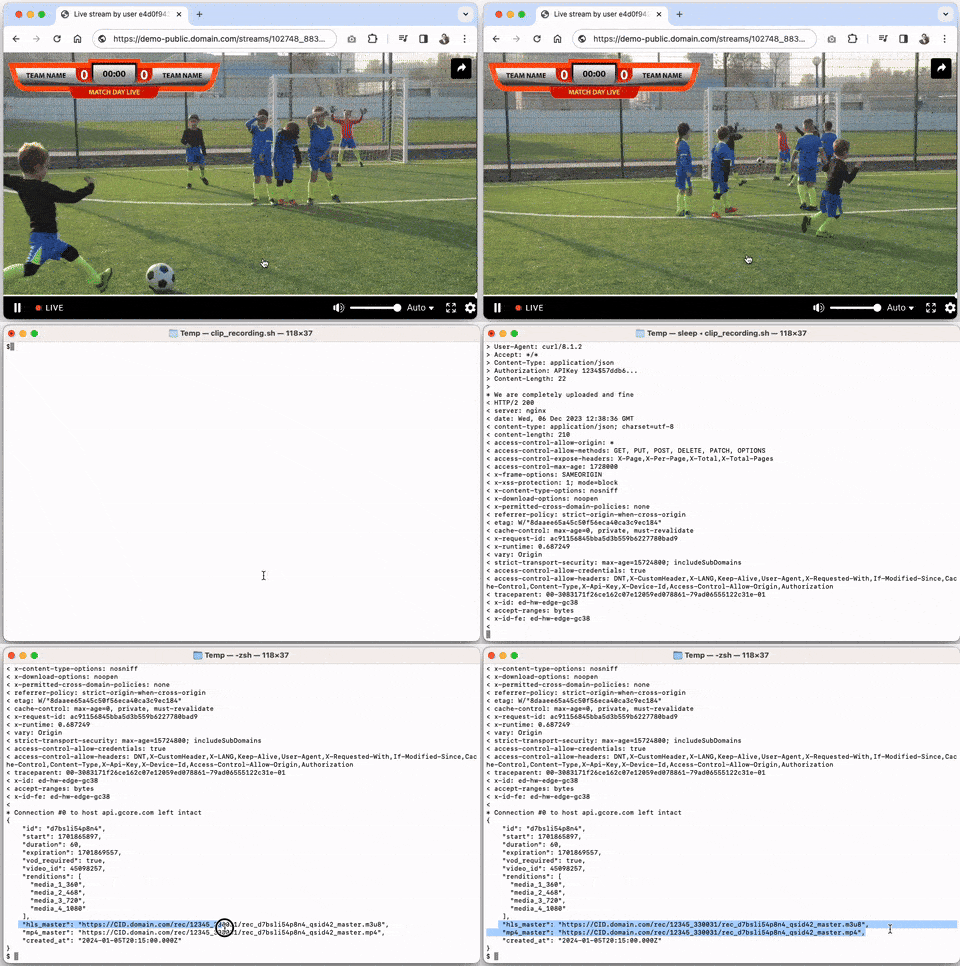
An API token is required. DVR must be enabled on the stream (
dvr_enabled: true). Clips are cut from the DVR buffer — the stream must be live and actively receiving an ingest signal.Enable DVR
dvr_duration sets the DVR buffer size in seconds (30–14400). The clip duration cannot exceed this window. Enable DVR by updating the stream:
- curl
dvr_enabled: true and dvr_duration: 3600.Create a clip
Cut a segment from an ongoing live stream. Specifyduration in seconds and optionally start as a Unix timestamp. The clip becomes accessible at start + duration — requesting it before that returns 425 Too Early. An expired clip returns 404.
Segment times are wall-clock times. Every segment of the live HLS playlist carries an EXT-X-PROGRAM-DATE-TIME tag with millisecond precision, and the MPEG-DASH manifest provides availabilityStartTime and ProducerReferenceTime. The MPEG-DASH manifest names https://time.gvideo.co/?iso&ms as its clock source (UTCTiming), and that endpoint returns the current UTC time to the millisecond. Use these values to convert an event time into start. In tests, EXT-X-PROGRAM-DATE-TIME ran about 1.6 seconds ahead of the encoder clock, so measure the offset for the encoder setup when frame-accurate alignment matters.
- Python SDK
- Go SDK
- curl
Create a clip from an earlier segment
To cut a segment from the past, passstart as a Unix timestamp:
- Python SDK
- Go SDK
- curl
vod_required: true. When the clip is created, the response includes a video_id. Use GET /streaming/videos/{video_id} to retrieve the permanent HLS/MP4 URLs once transcoding completes.
The clip response has no thumbnail fields. The linked video receives its five screenshots and the timeline sprite about 2 minutes after the clip is created, and the video request returns them. The mp4_master link is a single MP4 file at the highest rendition, and it downloads immediately, which suits editing or social publishing.
List clips
Retrieve all non-expired clips for a stream.- Python SDK
- Go SDK
- curl